
Ever pressed a pen into a page and watched the ink spread out like a small scratch, right through to the next sheet? That moment tells you everything about why paper choice matters more than most people realize. A cheap sheet turns a good pen into a mess. A rough surface turns a quick note into a challenge. And somehow, most people never stop to ask why.
Here’s the truth nobody in purchasing wants to hear: not all notebook paper is the same, and treating it that way is costing offices, schools, and small businesses more than they think. Bleeding ink ruins meeting records. Rough texture slows down students halfway through an exam. Bulk orders of the wrong stock end up sitting in a supply closet, unused and forgotten. None of that is dramatic, but it adds up fast.
So what actually makes notebook paper good? Three things, mostly: weight (measured in GSM, or grams per square meter), texture, and the ruling style printed on it. Get those three right for the job at hand, and a notebook stops being an accessory and starts being a tool that actually works the way it’s supposed to.
This guide breaks down eight distinct types of notebook paper, what each one is built for, and how to match the right stock to the way people actually write, plan, and take notes day to day.
Table of Contents
Quick Decision Framework: Which Notebook Paper Do You Need?
Before getting into specifics, it helps to have a shortcut. Not everyone reading this wants a full breakdown; some just need to know what to order by Friday. So here’s the fast version, built for quick scanning and quick decisions.
- Meeting minutes and clean corporate records → Woodfree offset or ruled paper
- Technical drawings, architecture, and math → Grid paper or graph paper
- Bullet journaling, habit tracking, and flexible planning → Dot grid paper
- Eco-conscious corporate gifting and green offices → Recycled or post-consumer paper
That covers the majority of use cases in one glance. For anyone who wants the reasoning behind these picks, the following sections go into more detail.
The Core Anatomy: Understanding Notebook Paper Specifications
Before comparing paper types side by side, it helps to understand what technically separates good stock from bad stock. Two notebooks can look nearly similar on a shelf and behave completely differently once a pen touches the page. The difference usually comes down to a handful of measurable factors that most buyers never think to check.
GSM (grams per square meter) is the first number worth knowing. Standard notebook paper sits around 70 to 80 GSM, which handles everyday ballpoint pens just fine. Anything under that starts to feel thin and lets ink show through. Fountain pen users, or anyone working with heavier ink flow, should look for 100 GSM or higher to avoid ghosting, where writing on one side becomes visible on the back of the page.
Notebook paper size matters just as much, especially for anyone ordering in bulk. A5 has become the default for personal journals and planners because it’s compact without feeling cramped. US Letter and legal-size dominate office and academic settings for obvious reasons: printers, binders, and filing systems all rely on them. Custom dimensions exist too, mostly for branded corporate notebooks or specialty products. For anyone who wants the official reference on paper dimensions, the ISO 216 international paper size standard and resources from the National Institute of Standards and Technology (NIST) lay out exactly how these measurements are defined and maintained.
Understanding these specs is really the difference between an ordinary paper and notebook combination and one that holds up under daily use, whether that’s a student’s backpack or a boardroom table.
The 8 Types of Notebook Paper and Their Best Uses
With the basics covered, it’s time to get into the actual options. Each type below solves a different problem, and none of them is universally “better”; they’re just built for different jobs. The goal here is matching the paper to the task, not picking whatever looks nicest in a catalog photo.
1. Lined/Ruled Paper (Wide, College, and Narrow Ruled)
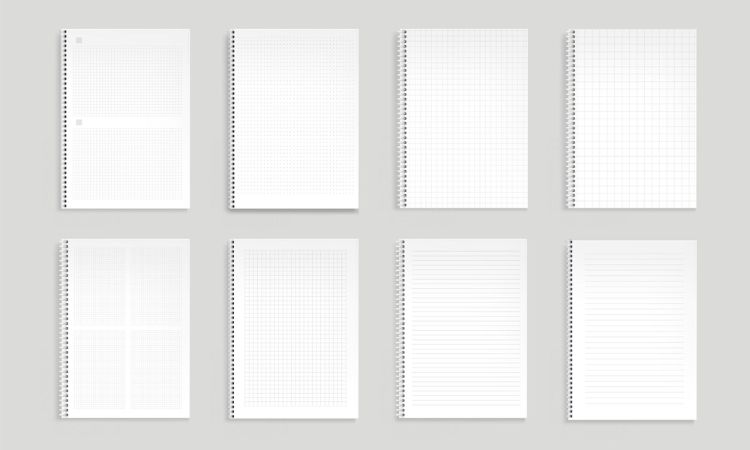
This is the notebook that most people imagine when they hear the word. Evenly spaced horizontal lines across the page. They make handwriting level and easy to read back later. You see it on legal pads and in classrooms, and with good reason: It works. Ruled notebook paper is useful for taking meeting minutes, keeping daily logs, and writing school notes. Anyone setting up a traditional school or classroom system will likely recognize this format from a standard composition notebook, which has used this exact layout for generations.
2. Grid Paper / Graph Paper
Grid paper trades horizontal lines for a full geometric grid, small squares formed by intersecting vertical and horizontal lines. It’s the go-to choice for anything involving measurement or space accuracy, engineering drafts, architectural sketches, math formulas, or tables that need to line up cleanly. A grid paper notebook removes the guesswork of drawing straight lines by hand, which matters a lot when precision is the whole point of the page.
3. Dot Grid Paper
A dot grid is somewhere between grid paper and blank paper, a soft matrix of little dots instead of solid lines. It gives you enough structure to keep your writing on track, but without the visual distractions of a full grid. This notebook paper is a popular format for bullet journaling, agile project tracking, and calligraphy-style planning, where flexibility is as important as order. It’s a good example of how paper and notebook design is still changing to fit newer, more personal ways of working.
4. Blank / Unruled Paper
Sometimes structure can be limiting. Blank paper strips away every line, dot, and grid, leaving nothing but open space. That flexibility is exactly what makes it useful for mind mapping, visual brainstorming, and rough sketching, tasks where ideas need room to spread out in whatever direction they naturally go. Writers who prefer open-ended layouts often prefer a dedicated notebook for writing built specifically around this kind of unrestricted format.
5. Woodfree Offset/Bond Paper
This is smooth, chemically treated, uncoated paper made to last. It resists yellowing far longer than standard stock and handles gel or fountain pen ink without feathering or bleeding through. That combination makes it a natural fit for executive corporate journals, official registers, and premium promotional notebooks meant to represent a brand well. Companies looking to outfit their office with professional notebooks usually end up here, since the paper quality directly depends on the company handing it out.
6. Cream/Ivory Tinted Paper
Not every page needs to be plain white. Cream and ivory paper is a much warmer, softer alternative that greatly reduces eye strain, especially in harsh fluorescent office lighting. Often used in long-form journaling and luxury diaries, it is paired with leather-bound covers for a more reflective, personal touch. This is also where the line between notebook vs journal becomes clearer: one is built for quick, functional notes, the other for slower, more thoughtful writing, and the paper stock tends to follow that distinction.
7. Recycled / Eco-Friendly Paper
Made from post-consumer waste or other sustainable fiber sources, often FSC-certified, recycled paper has improved significantly from the rough, grayish stock people remember from years ago. Modern recycled paper writes easily and wears well, making it a good choice for eco-conscious corporate gifting, green office projects, and student notebooks where sustainability is a consideration for the buyer.
8. Heavyweight Card / Mixed Media Paper
At the thicker end of the range sits heavyweight card stock, built to withstand heavy marker use, mixed media projects, and general wear over time. It shows up most often as section dividers, custom notebook covers, or scrapbooking pages, anywhere that a standard sheet would bend or bleed through under pressure.
How to Choose Based on Your Industry or Use Case?
Knowing the eight types is only half the picture. The other half is matching them to the actual people who will use them, because a supplier manager, a teacher, and a project planner are all solving different problems, even when they’re technically buying “notebooks.”
Corporate and procurement managers need to think beyond price per unit. The paper stock chosen for a corporate gifting program says something about the brand handing it out, and cheap, thin paper tends to say the wrong thing. Bulk orders should prioritize stock that reflects quality without inflating cost past what the budget allows, which is where custom journals come in handy for branded executive giveaways.
Educators and students deal with a different set of pressures entirely. Notebooks get thrown into backpacks, dropped, and handled roughly every single day. Durability matters just as much as the notebook paper size, since a page that tears easily or a binding that falls apart mid-semester creates real problems for anyone relying on it for daily coursework.
Professionals and planners are usually optimizing for something less obvious: information retention. The right layout, whether that’s ruled, dot grid, or grid paper, can genuinely change how well someone remembers what they wrote. Anyone building a system around effective note-taking should treat paper choice as part of that methodology, not just a container for it.
Conclusion
Matching the right notebook paper type to the right workflow turns an ordinary writing habit into something that actually feels seamless: no more bleeding ink, no more squinting under office lights, no more notebooks that fall apart halfway through the semester. It’s a small decision that quietly affects a lot of daily problems most people never bother to fix. Whether the need is bulk legal pads for a growing office, custom-printed corporate journals for an upcoming event, or specialized stationery for a school district, usapad offers tailored paper weights, sizes, and branding options, all made in the USA.
FAQs
What GSM is best for notebook paper?
For everyday ballpoint or pencil use, 70 to 80 GSM works fine and keeps the notebook light. Anyone who writes with gel pens or fountain pens should move up to 100 GSM or higher; otherwise, ink tends to show through to the next page.
What’s the difference between a dot grid and grid paper?
Grid paper has full lines running both directions, forming a solid checkerboard pattern. A dot grid keeps only small dots where those lines would intersect, giving enough guidance to keep writing straight without the busy look of a full grid. Most bullet journal users prefer dots because sketches and text blend into the page more naturally.
Is recycled notebook paper as durable as regular paper?
Yes, in most cases. Older recycled paper had a rough, low-quality reputation, but modern FSC-certified recycled stock writes smoothly and holds up close to standard paper. The main difference buyers notice is a slightly warmer, less bright white tone, not weaker performance.
Can the wrong notebook paper actually affect handwriting or note quality?
It can, more than people expect. Rough or too-thin paper drags on the pen and tires the hand faster, which leads to poorer writing over a long session. A good weight and texture keep the pen gliding smoothly, so notes are readable and easy to look back on later.