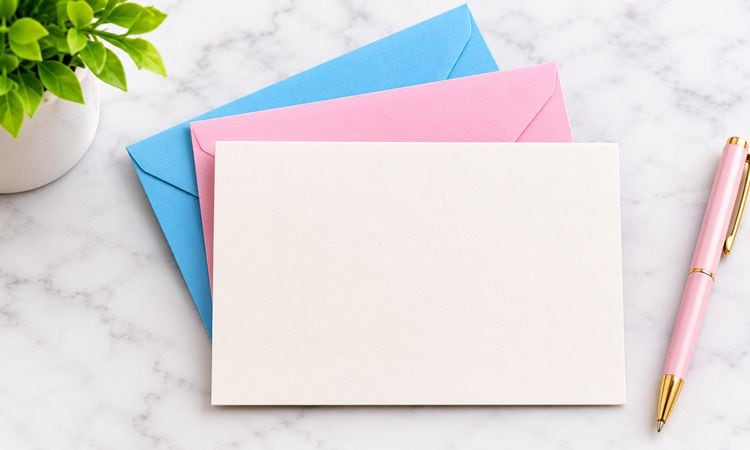
Need to send a thank-you message, write a short note to a client, or add a personal message to a gift? Notecards give those messages a simple format without the space or formality of a full letter. Their small size makes them useful for everyday personal and professional communication.
The word “notecard” could be a little confusing because it can refer to two different types of cards. Stationery notecards are made for written messages and correspondence, while index cards are often used for study notes, reminders, and quick reference.
What the card needs to do determines the right card. Choice can be affected by size, paper, format, personalization, customization, envelopes, and quantity.
Table of Contents
What Are Notecards?
Notecards are small cards used for short written messages. They are often used in thank-you notes, greetings, personal correspondence, and business messages. They are one type of stationery cards, with formats designed for different kinds of written communication.
They come in two basic physical formats. A flat notecard gives one writing surface, while a folded notecard opens to provide more room inside.
The design can be simple or more personal. A blank card leaves the message to the writer. Printed cards can include a design or wording, while personalized and custom notecards can include names, initials, monograms, logos, artwork, or other details.
Notecards vs. Index Cards
Notecards and index cards can look almost the same at first, which is why the two names sometimes get mixed up. The main difference is what people usually use them for.
A notecard is made for short messages and correspondence. It can be used for:
- Thank-you notes
- Personal greetings
- Short business messages
- Invitations
- Notes to customers or clients
An index card is more often used to keep information handy. Students can write definitions, questions, or key points on them as they study. They can also be good for reminders, lists, and other quick notes to refer to.
The names are often interchangeable, but the intended use usually makes the difference clear. In this guide, “notecards” refers to stationery cards used for personal or professional messages, not study or reference cards.
What Are Notecards Used For?
Sometimes a message is too personal for an email but too short for a letter. That is where a notecard fits well. A few handwritten lines can be used to thank someone, add a message to a gift, or stay in touch with friends and family.
They are also useful at work. A business might send a short thank-you to a client, follow up after a meeting, or include a personal note with an order. For birthdays, graduations, weddings, and holidays, the same small format can carry a simple greeting or good wishes.
Notecards can also serve less formal purposes. Someone might keep a phone number on one, write down a reminder, or make a small list that needs to stay nearby.
The use usually determines the card. A few lines may fit comfortably on a small flat card, while a longer message may call for a larger or folded one.
What Types of Notecards Are Available?
Notecards can be grouped in a few ways. Some differences relate to how much personalization they offer, while others relate to the card’s actual format or intended use.
Blank Notecards
Blank notecards leave the message to the writer. They work well when the same stationery needs to suit different occasions. A blank card can hold a thank-you note, greeting, personal message, or short business note without being tied to one specific event.
Personalized Notecards
Personalized notecards include details connected to the person using them. Names, initials, monograms, and addresses are common examples. Personalized note cards can work well as personal stationery when you want the design to include your own details. The design can stay simple while those details give the card a more personal feel.
Custom Notecards
Custom notecards are made around specific requirements. These may include a particular design, artwork, brand details, colors, layout, or card format. They can be useful for businesses, events, or personal stationery that needs a design created for a particular purpose.
Flat Notecards
Flat notecards do not fold. They provide one writing surface and work well for short messages, artwork, logos, and business stationery. They are also useful when the message does not need a separate inside panel.
Folded Notecards
Folded notecards open to reveal additional writing space. They are useful when a message needs more room or when the inside of the card will carry the main text. The front can hold a simple design while the inside provides space for the message.
Business Notecards
Business notecards are made for short professional communication. They may include a company name, logo, contact details, or other brand information.
Companies can use them for customer notes, customer communication, employee recognition, and so on. Custom stationery can also help keep the card design consistent with other company materials.
What Are the Common Notecard Sizes and Dimensions?
Notecards come in different sizes, and the right one depends on the message. A card for a few lines does not need the same amount of room as one carrying a longer note, artwork, or a business logo.
Common Notecard Sizes
There is no single size that applies to every notecard. These dimensions are useful reference points rather than universal standards.
| Size | Example dimensions | Typical use |
| Small | 3 × 5 inches | Short notes and references |
| Medium | 4.25 × 5.5 inches | General correspondence |
| Large | 5 × 7 inches | Longer messages and designs |
| Custom | Varies | Business, events, and special projects |
A 3 × 5-inch card suits a short message and takes up little storage space. A 4.25 × 5.5-inch format gives more room for everyday correspondence.
The 5 × 7-inch format leaves more space for longer messages, photos, artwork, or printed details. Custom dimensions are useful when a project needs a particular size.
Notecard Size and Writing Space
The amount of text planned for the card should guide the choice. A few lines may fit comfortably on a small card, while a longer message needs more room.
Printed details use part of that space too. A card with a name, logo, or artwork should leave enough space for a handwritten message if one is expected.
A folded notecard offers another option. The closed card stays compact while the inside provides an additional writing panel.
Size, Design, and Portability
The card size is also a factor in the design. A name, monogram, or decorative flourish looks good on a small card. A larger card provides more space for photos, artwork, logos, and other printed elements.
Storage is worth considering too. Small cards fit easily in drawers, stationery boxes, and bags. Larger cards need more room, especially when several sets are stored together.
Notecard Size, Envelopes, and Mailing
The envelope should be large enough to hold the card comfortably without bending or forcing it inside. For a folded notecard, the relevant size is the card when it is closed.
Mailing requirements apply to the complete mailpiece. USPS has separate requirements for postcards and letters, including dimensions, thickness, and shape. A stationery notecard should not automatically be treated as a postcard simply because it is small.
For a larger order, check the card and envelope together before production. The finished size should work for the message, design, storage, and intended mailing method.
What Paper Is Best for Notecards?
Paper affects how a notecard feels and how well it handles writing or printing. This also matters when choosing other custom paper products for writing and business use. A card meant for handwriting needs a comfortable writing surface, while one made mainly for photos or artwork needs paper that presents the design well.
Cardstock for Notecards
Regular printer paper is usually too light for a finished stationery card. Cardstock gives a notecard more body and makes it easier to handle and mail.
A lighter cardstock is appropriate for everyday notes, whereas a heavier stock may be preferred for business stationery, invitations, or event cards.
Paper Texture and Writing
A smooth surface is often best for handwritten notes. It is easy to write on, and the writing remains clear. Textured paper has a more noticeable surface and can suit decorative stationery. The texture should still allow the chosen pen to write comfortably.
Coated vs. Uncoated Paper
The choice often depends on what will be printed and whether the recipient will write on the card.
- Uncoated: Well suited to handwritten messages and a traditional paper feel.
- Coated: Useful for photographs, graphics, and detailed printed artwork.
A heavily coated surface can be less convenient for handwriting, so it may not suit a card that recipients are expected to write on.
Paper for Writing vs. Printing
If the card will mainly carry handwriting, the writing surface should be prioritized. If the design includes detailed graphics or photos, print quality becomes more important.
Cards that need both should be tested before a large order. A paper sample can show how the chosen pen and printing method work on the surface.
How Should You Store and Organize Notecards?
Notecards are easy to lose when different sets end up in the same drawer. Keeping them in one place makes it easier to find the right card without sorting through every design.
Notecard Holders and Storage Options
A desk holder works well for cards used often. Cards kept for special occasions can go in a small box or drawer, while a stationery case is useful when a few cards need to be carried.
Whatever the storage method, give the cards enough room to stay flat. Keep the matching envelopes nearby so they are ready when the card is needed.
Keeping Different Notecard Types Organized
Different cards are easier to manage when they have separate places. Personal stationery, business cards, thank-you cards, and holiday designs can each have their own section.
Simple labels can help. A box marked “Thank You,” “Business,” or “Holiday” makes it easier to find the right set without opening every pack.
It’s easier to work with personalized and custom cards when each design is kept together. This prevents confusion between names, monograms, and business designs.
How Do You Choose the Right Notecard?
Think about the message before picking the card. If there are only a few lines to write, a small card may be all that is needed. A longer note will be more comfortable on a larger or folded card.
The way the card will be used matters too. Someone writing by hand will usually care about the feel of the paper and how easily a pen moves across it. A card covered with photos or detailed artwork needs paper that can handle the chosen printing method.
Personal stationery may only need a name or monogram. A business card might need a logo and other company details. For an event, the design may need to match the occasion.
Quantity is another simple consideration. A few cards are enough for occasional personal notes, while a business or event may call for a larger set. If the cards will be mailed, the envelope should be checked at the same time to make sure everything fits properly.
In short, choose the card around the message, how it will be used, and how many are needed. That keeps the decision simple without adding features that are not necessary.
Conclusion
Picking a notecard does not have to be difficult. Start with what the card is for, then choose a size and paper that give the message enough room. A simple card works well for a quick thank-you or personal note. For business stationery, gifts, or special occasions, a personalized or custom design can add a more unique element.
FAQs
Is it “notecards” or “note cards”?
Both forms are used. “Notecards” is written as one word, while “note cards” is written as two. Either form can refer to stationery cards.
What Is a Notecard?
A notecard is a small card used for writing a short message. Stationery notecards can be flat or folded and may be blank, printed, personalized, or custom-made.
What Are the Best Notecards Available?
The uses of this decide which one is best from available options; for example, the size and writing surface are important for handwritten notes, and the other one with photos or detailed artwork requires paper suited to the printing method.
How Do I Make My Own Note Cards?
Select a card size, design it, and print it on appropriate card stock. These can then be cut to size and paired with envelopes. Matching envelopes can be purchased separately or as part of a stationery set.