
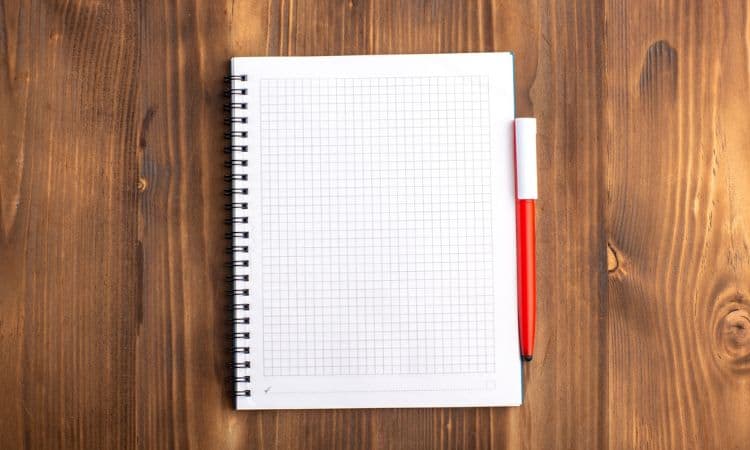
Open a grid paper notebook, and you’ll first notice the pattern: rows and columns of tiny squares across every page. That structure isn’t decoration. It’s a built-in reference system that keeps graphs, diagrams, tables, and technical sketches lined up without reaching for a ruler. The catch is that not every grid paper notebook works for every job.
A notebook meant for architecture sketches won’t feel the same in a math class, and a fine 5mm grid isn’t always the right call for someone who just wants neat and clean handwritten notes. This guide walks through what a grid paper notebook actually is, where it earns its keep, and how to pick one that matches what you’re actually going to do with it.
Table of Contents
What Is a Grid Paper Notebook?
A grid paper notebook is a notebook where every page is printed with evenly spaced horizontal and vertical lines that cross to form small squares. That’s the whole idea in one sentence, but the details of how those lines are set up change the notebook’s usefulness.
How Grid Paper Is Structured
The horizontal and vertical lines repeat across the page at a fixed distance, so every square is the same size as the one next to it. That consistency gives you a reference point wherever your pen lands: you always know how far one line, letter, or box sits from the next.
Grid spacing isn’t fixed across all notebooks, though. Some pages use a tight grid with many small squares packed into an inch, while others space the lines further away. The right spacing depends entirely on what’s going on the page.
Grid Paper and Graph Paper
Most people use “grid paper” and “graph paper” to mean the same thing, and in everyday conversation, that’s fine. Graph paper is really just the more common name for paper printed with a regular grid, and you’ll see both terms used on packaging and in product listings. You don’t need to worry about which word is “correct.” If a listing says graph paper notebook instead of “grid notebook,” it’s describing the same kind of page.
What Is a Grid Paper Notebook Used For?
The grid isn’t just visual. It changes what you can comfortably do on a page compared to lined or blank paper, and the uses stretch well beyond a math classroom.
Math and Graphing
This is the classic use, and for good reason. A grid gives you fixed reference points for plotting coordinates, drawing graphs, working through geometry, and keeping numbers aligned in long calculations. When you’re sketching a shape at a particular scale, the squares act as a built-in unit of measurement, so you don’t need to keep reaching for a ruler. Anyone who’s tried to plot a function on blank paper and watched the line wander off course knows exactly why its use matters.
Technical and Engineering Sketches
Grid paper shows up constantly in technical fields because it supports freehand sketches that still need to look proportional. An engineer roughing out a bracket, or a student practicing basic drafting, can use the grid to keep angles and lengths in reasonable proportion without formal drawing tools. It won’t replace CAD software or a drafting table, but for quick layouts and early-stage sketches, the built-in structure saves a lot of back-and-forth measuring.
Tables, Charts, and Organized Notes
Not every use is technical. A grid paper notebook makes it noticeably easier to build tables by hand, keep columns aligned, and organize information into clear sections. Students building comparison charts, professionals sketching quick diagrams during a meeting, and anyone who just wants notes that don’t sprawl across the page will find that the grid does a lot of the organizing work automatically.
Planning and Design
The grid also works well for basic layout planning: sketching how elements might sit on a page, blocking out a simple design, or laying out a pattern before committing to it. It won’t make someone more creative, but it does make it easier to turn a rough idea into something with proportion and order, which is often the hardest part of getting started.
What Types of Grid Paper Are Available?
Grid paper comes in a variety of different formats, and picking the wrong one is a common reason people end up upset with a notebook that otherwise looked perfect.
Standard Square Grid
This is the format most people picture when they hear “grid paper.” Regular horizontal and vertical lines cross to form even squares across the whole page, and it works for general graphing, structured notes, diagrams, and everyday layouts. If there’s a default choice for a grid paper notebook, this is it.
Specialized Grid Formats
Beyond the standard square grid, there are formats built for particular kinds of drawing. Isometric grid paper, for example, uses angled lines instead of straight verticals and horizontals, which makes it useful for sketching 3D objects that need to look dimensional on a flat page. These specialized formats exist because certain technical and drawing tasks genuinely need something other than a square grid, though most people won’t need to go beyond a standard square grid for everyday use.
Dot Grid
Dot grid paper swaps continuous lines for small, evenly spaced dots at each intersection. It gives the same underlying structure as a grid, but with a much smoother page, since there are no solid lines running edge to edge. That makes it popular for bullet journaling and creative layouts where a full grid feels too busy.
A dot grid notebook serves a different purpose than a traditional grid one: it’s built more for flexible planning than exact technical work, and it deserves its own separate look if that’s what you’re after.
What Grid Size Should You Choose?
Grid size refers to the distance between lines, and this is where a lot of buyers get stuck picking between a 4mm grid, a 5mm grid, or something else entirely.
A smaller, finer grid packs more reference points into the same amount of space. That makes it useful for detailed plotting, precise diagrams, or anyone whose handwriting runs small. A bigger, rougher grid does the opposite: it gives you more room inside each square, which is good for larger handwriting or simpler layouts where you don’t need fine detail.
There’s no single grid size that works best for everyone, and it’s worth being skeptical of any claim that says otherwise. The right spacing depends on the scale of what you’re drawing, how much detail the task needs, and honestly, how small you’re comfortable writing. Someone doing detailed technical sketches will usually reach for a finer grid than someone jotting quick notes in a meeting.
Grid Paper vs. Lined, Blank, and Dot Grid Paper
Choosing between page types often depends on how much structure you want on the page. Here’s how the main formats compare:
| Paper Type | Best Suited For |
| Grid paper | Graphs, diagrams, tables, structured layouts |
| Lined paper | Conventional writing and long-form notes |
| Blank paper | Freehand drawing and unrestricted layouts |
| Dot grid paper | Flexible layouts with lighter visual guidance |
Choose grid paper when you need visible horizontal and vertical guides for things like graphs or diagrams. Choose lined paper when continuous writing is the main task, since horizontal rules support handwriting better than a full grid does. Choose blank paper when you’d rather have no printed guides at all. And choose a dot grid when you want some structure without the visual weight of solid lines running across the page.
Grid pages come with one important benefit worth mentioning here: the structure of a grid helps keep letters and numbers aligned as you write, which is part of why some people reach for a grid notebook even for tasks that aren’t strictly technical.
How to Choose the Best Grid Paper Notebook
Once the basics make sense, choosing the best grid paper notebook is about matching a few practical decisions to how you’ll actually use it.
Start With Your Main Use
Before anything else, figure out what the notebook will mostly be used for. Math and graphing, technical sketching, structured notes, or planning and design all pull toward slightly different choices. Someone using a notebook for detailed engineering sketches has different needs than someone using it to keep meeting notes tidy, and being honest about the main use makes every decision after this one much easier.
Choose the Right Grid Spacing
Using the earlier grid-size guidance, pick a spacing that fits how much detail your work needs and how large you naturally write. Finer grids suit precise, detailed work; coarser grids suit bigger handwriting and simpler layouts.
Pick the Right Notebook Size
Notebook size involves a basic trade: smaller formats are easier to carry around all day, while larger formats give you more room to work on each page. Neither one is universally better. A pocket-size notebook is ideal for someone who needs it on hand constantly, while a full letter-size notebook makes more sense for someone doing detailed diagrams at a desk.
Consider Paper and Binding
Check how the paper surface handles your usual pen or pencil, since some papers feel scratchy with certain tools and others handle ink better than others. Binding matters too: spiral and wire-bound notebooks lie flat for smooth writing, while sewn or glued bindings hold up better over years of daily handling.
Check Page Count and Cover
Finally, think about how long the notebook needs to last and how often it’ll get used. A notebook for a single semester of coursework has different needs than one meant to last for years of ongoing project notes, and a sturdier cover matters more if the notebook is going to spend a lot of time in a bag.
When Is a Custom Grid Paper Notebook a Better Choice?
Sometimes a standard grid paper notebook does not quite fit the job, and that is when it makes sense to look at custom options instead.
A custom grid paper notebook makes sense when a specific grid format is required for a particular project or when a standard notebook simply doesn’t offer the inside-page layout that’s needed. It’s also worth considering for businesses or organizations that want branded notebooks for staff, clients, or events, since a custom cover and interior layout can carry a logo or specific technical information that a generic notebook can’t.
Schools, businesses, and organizations ordering in larger quantities also usually find custom options more practical than buying standard notebooks one by one. If any of that sounds like your situation, designing a custom notebook is usually a more direct path than trying to make a standard one work.
Conclusion
A grid paper notebook earns its place when the work benefits from structure: keeping graphs accurate, tables aligned, or sketches proportional. There’s no single best version of it, though. The right choice depends on what you’re actually going to use it for, and that shapes everything from grid spacing to notebook size, paper, binding, and page count. For anyone with more specific requirements than a standard notebook can meet, a custom option is worth a closer look before settling.
FAQs
What is a grid paper notebook?
It’s a notebook with small, evenly spaced squares printed on every page instead of plain lines. Those squares give you something to line up against, whether you’re sketching, graphing, or just trying to keep your handwriting from wandering across the page.
Are grid paper and graph paper the same?
Pretty much, yes. People use the two names interchangeably, and you’ll see both on packaging without any real difference in the product. Graph paper just happens to be the more common name for it, so don’t overthink the wording.
Is a grid notebook good for math?
Yes, a grid notebook is a perfect choice for math because the squares help to write equations cleanly, and you can draw graphs and keep the numbers in the right place.
Can grid paper notebooks be customized?
Yes, and more than people expect. Grid size, page layout, cover design, and even branding can all be adjusted to fit a specific project or business. If a standard notebook off the shelf isn’t quite right, it’s usually worth considering a custom one.